

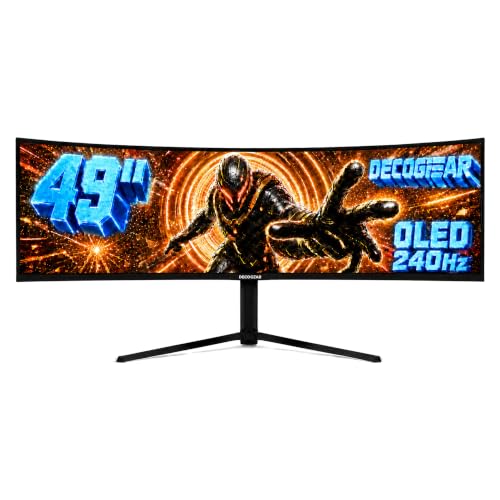
The Deco Gear DG49OLED240 is the kind of gaming monitor that can make a traditional dual-screen setup feel outdated. Its huge 49-inch 32:9 display effectively combines two 27-inch QHD monitors into one seamless canvas, without a bezel running through the middle.
At its core is a QD-OLED panel with a 5120 x 1440 resolution, 240Hz refresh rate and 0.03ms response time. That combination delivers the deep blacks, vibrant colors and exceptionally fast response that make OLED particularly compelling for gaming.
The competition is strong. The LG UltraGear Evo GX9 39GX950B-B takes a sharper approach with a 39-inch 5K2K OLED display, while Samsung’s 57-inch Odyssey Neo G9 G95NC goes dramatically bigger with a dual-4K Mini-LED panel. The Deco Gear sits between them, targeting a balance of size, speed and image quality.
The result is one of the more interesting super-ultrawide options for gamers who want a single display for gaming, multitasking and everyday use. It isn’t the sharpest or brightest option in this class, but its combination of 49-inch QD-OLED, 32:9, 240Hz and 0.03ms response makes a compelling case.
Specifications
- Display: 49-inch QD-OLED
- Resolution: 5120 x 1440
- Aspect ratio: 32:9
- Refresh rate: 240Hz
- Response time: 0.03ms
- Curve: 1800R
- HDR: DisplayHDR 400
- Color: 10-bit, wide DCI-P3 coverage
- Adaptive sync: FreeSync & G-Sync Compatible
- Connectivity: HDMI 2.1, DisplayPort 1.4, USB-C
- USB-C: Up to 90W power delivery
- Audio: 2 x 5W speakers + 10W woofer
- Multitasking: PIP/PBP
Design & Build

The Deco Gear DG49OLED240 is a substantial monitor, but its clean black finish, slim bezels and relatively understated design prevent it from looking overly aggressive. The 1800R curve adds immersion without being as extreme as Samsung’s 1000R design.
Its sturdy stand provides height, tilt and swivel adjustment, although you’ll need a sizeable desk. Compared with the LG GX9, the Deco Gear is considerably wider, while the LG’s smaller 39-inch design is easier to accommodate.
The LG has the advantage in pixel density. Its 5120 x 2160 5K2K resolution produces sharper text and finer detail, while the Deco Gear prioritizes width, effectively providing the workspace of two 27-inch QHD monitors.
Samsung’s 57-inch Neo G9 is in another league for physical size, with its 1000R curve creating an even more enveloping experience. The Deco Gear is much easier to fit into a conventional gaming setup.
Connectivity is strong, with HDMI 2.1, two DisplayPort 1.4 ports, USB-C, USB connectivity and a 3.5mm headphone jack. USB-C supports up to 90W power delivery, making the monitor useful as a single-cable display and charging solution for compatible laptops.
Overall, the Deco Gear occupies a sweet spot between its rivals: more expansive than LG’s 39-inch OLED but considerably more manageable than Samsung’s 57-inch Neo G9.
Features
The headline feature is obviously the 49-inch 32:9 QD-OLED panel. The 5120 x 1440 resolution gives you enormous horizontal workspace while retaining the visual advantages of OLED, including deep blacks, high contrast and vibrant colors.
Gaming is where the specifications become particularly impressive. The 240Hz refresh rate and 0.03ms response time are designed for fast, fluid gameplay, while FreeSync and G-Sync compatibility help reduce tearing and stuttering.
HDR10 and DisplayHDR 400 are supported, while the 10-bit panel and wide DCI-P3 coverage help produce richer colors. Samsung’s Neo G9 remains the stronger choice if extremely bright HDR highlights are your priority, but OLED has the advantage when it comes to black levels.
For productivity, PIP/PBP support allows multiple sources to be displayed simultaneously. Combined with USB-C, the USB hub and built-in speakers, the DG49OLED240 is capable of functioning as both a gaming display and a serious multitasking monitor.
Gaming Performance

The DG49OLED240 is at its best when gaming. Its 5120 x 1440 resolution, 240Hz refresh rate and 0.03ms response time produce exceptionally smooth motion, while the QD-OLED panel gives games tremendous contrast and rich colors.
In Cyberpunk 2077, the OLED panel is particularly well suited to Night City. Neon signs, bright lights and dark streets stand out against deep blacks, while the 32:9 aspect ratio expands the view across the city. Red Dead Redemption 2 and The Witcher 3 similarly benefit from the wider perspective, making their expansive environments feel more cinematic.
Racing games are another strong use case. Forza Horizon 5 benefits from the enormous horizontal field of view, while the 240Hz refresh rate keeps high-speed movement fluid. Simulation titles can also take advantage of the additional screen real estate when 32:9 is properly supported.
Competitive games including Counter-Strike 2, Valorant, Call of Duty: Warzone and Overwatch 2 benefit more from the monitor’s speed. The 240Hz refresh rate and extremely fast OLED response keep motion clear during rapid movements, although reaching high frame rates at 5120 x 1440 requires powerful graphics hardware.
The biggest caveat is game compatibility. Not every title handles 32:9 perfectly, and some games can introduce black bars, unusual menus or restricted field-of-view options. When a game properly supports super-ultrawide, however, the extra horizontal space can be transformative.
Three super-ultrawides, three different priorities
| Feature | Deco Gear DG49OLED240 | LG 39GX950B-B | Samsung Neo G9 G95NC |
| Screen | 49-inch | 38.86-inch | 57-inch |
| Aspect ratio | 32:9 | 21:9 | 32:9 |
| Panel | QD-OLED | Tandem WOLED | VA Mini-LED |
| Resolution | 5120 x 1440 | 5120 x 2160 | 7680 x 2160 |
| Refresh rate | 240Hz | 165Hz native | 240Hz |
| Response time | 0.03ms | 0.03ms | 1ms |
| Curve | 1800R | 1500R | 1000R |
| Best strength | Balance | Sharpness | Size |
| Best for | Gaming + multitasking | Productivity + gaming | Extreme immersion |
| Main compromise | Lower pixel density | Smaller screen | Huge GPU requirement |
The LG 39GX950B-B is the better choice if sharpness and productivity are equally important. Its 5120 x 2160 resolution gives it a clear advantage when reading text or working with detailed interfaces.
The Samsung Neo G9 G95NC is the ultimate option for sheer scale and resolution. Its 57-inch 7680 x 2160 panel is spectacular, but that enormous resolution places substantially greater demands on your graphics hardware.
The Deco Gear takes the middle ground. It doesn’t beat either rival in every category, but it arguably offers the most balanced gaming package.

Verdict
The Deco Gear DG49OLED240 is an excellent super-ultrawide gaming monitor. The combination of a huge 49-inch QD-OLED panel, 32:9 aspect ratio, 240Hz refresh rate and 0.03ms response makes it particularly impressive for immersive and fast-paced gaming.
It isn’t the sharpest or brightest monitor here. The LG GX9 wins on pixel density and productivity, while Samsung’s Neo G9 delivers a larger display, higher resolution and brighter Mini-LED HDR.
But that’s exactly why the Deco Gear is so compelling. It hits the sweet spot between them, offering OLED image quality and extreme ultrawide immersion without requiring the enormous physical footprint and GPU horsepower of Samsung’s 57-inch flagship.
Should you buy it?
Buy it if…
You want to replace two monitors
The 49-inch 32:9 canvas provides the workspace of two 27-inch QHD displays without a bezel in the middle.
You want immersive OLED gaming
QD-OLED, 49 inches and 240Hz make supported games look spectacular.
You want 240Hz without going all the way to dual-4K
5120 x 1440 is considerably easier to drive than Samsung’s 7680 x 2160.
You want one monitor for everything
Gaming, multitasking, productivity and media consumption all benefit from the enormous canvas.
Don’t buy it if…
You want the sharpest ultrawide image
The LG 39GX950B-B’s 5120 x 2160 resolution is significantly sharper.
You want the brightest HDR
Samsung’s Neo G9 is better suited to high-brightness HDR.
You have a small desk
A 49-inch 32:9 monitor takes up a lot of horizontal space.
You primarily use static productivity applications
A high-PPI 4K or 5K2K display may be a better fit for text-heavy work.
Also consider
LG UltraGear Evo GX9 39GX950B-B
Choose the LG if sharpness and productivity matter as much as gaming. Its 5K2K resolution gives it a significant advantage for text and detailed desktop work.
Read the full LG 39GX950B-B review
Samsung Odyssey Neo G9 G95NC
Choose Samsung if you want the largest and most extreme experience possible. Its 57-inch dual-4K display is spectacular, but its size and GPU requirements make it a much more specialized purchase.
Read the full Samsung G95NC review
Price Comparison


Disclosure: VARGE is reader-supported. When you buy through links on this page we may earn an affiliate commission, at no extra cost to you. Our picks are chosen on the merits — commissions never influence the ranking. Read more.